
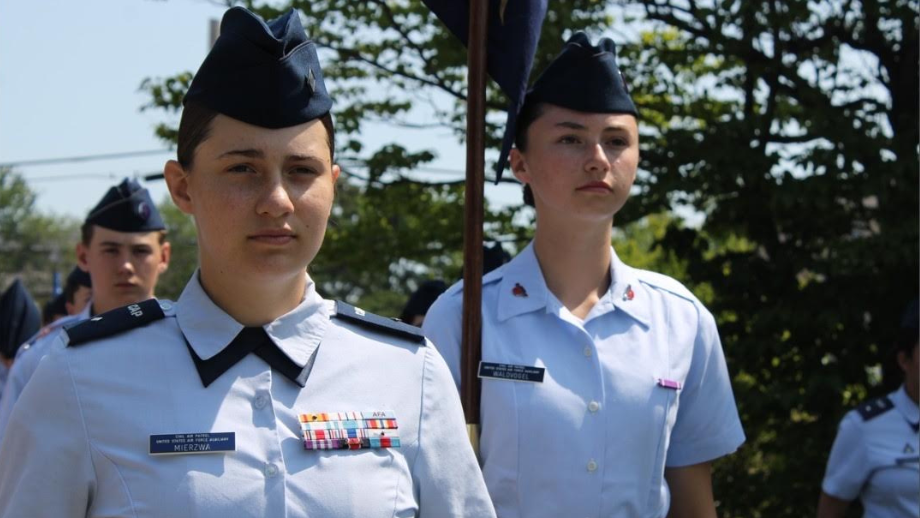

Kelly Meirzwa
Once a Cadet, Always a Cadet
Deputy Commander for Cadets Finance and Fundraising
Table of Contents
A Commitment to Service, Leadership and Community
Kelly Mierzwa did not set out to become a leader in Civil Air Patrol.
Four years ago, she set out to get breakfast donated.
The local Civil Air Patrol squadron was preparing for an open house at the former Loring Air Force Base in Limestone, and Kelly offered to help find a community partner willing to provide the food. Her approach to fundraising was straightforward, but persistent.
“I’ve always believed that fundraising is less about finding the right person and more about being willing to ask enough people,” she says. “If 10 out of 100 say yes, then I’ll simply ask 1,000. Eventually, persistence turns possibility into opportunity.”
There was just one problem: she needed to be a Civil Air Patrol member to help.
So Kelly joined.
What started as an offer to help with breakfast became a commitment to volunteer service, and eventually led her to her current role as Deputy Commander of Cadets for the County Composite Squadron (ME-033), based at Presque Isle International Airport.
Today, Kelly works alongside other dedicated volunteers to help young people develop leadership, character, confidence and a lifelong commitment to service.
Civil Air Patrol’s Core Values, Integrity, Volunteer Service, Excellence and Respect are more than words to Kelly. They are principles she tries to demonstrate in the way she leads and mentors young people

The Lasting Impact of the Cadet Experience
Ask Kelly what she values most about Civil Air Patrol, and her answer comes back to the cadets.
She believes every young person deserves the opportunity to belong to something meaningful, contribute to a team, step into leadership and discover just how much they are capable of accomplishing.
“Young people need to be surrounded by others who challenge them to do better. If a cadet is struggling to make the right choices, bring them into a group of cadets who are doing the right thing. The hope is that the strength of that group will help them find their own.”
That belief, that the right environment can shape a young person’s choices, confidence and future, is at the heart of the County Composite Squadron.
Civil Air Patrol’s Cadet Program combines leadership, aerospace education, physical fitness and character development with hands-on experiences that allow young people to gradually take on greater responsibility.
A young person who joins may begin by learning how to wear a uniform, participate in formation and work as part of a team. Over time, that same cadet may find themselves teaching younger cadets, leading a team, organizing an activity, participating in emergency services training or representing the squadron at a community event.
The opportunities extend well beyond the squadron.
Cadets can participate in aviation experiences, emergency services training, scholarships, encampments, state and national activities, leadership programs and specialized opportunities in aviation, aerospace, technology and other fields.
For Kelly, the greatest reward is watching a young person discover a possibility they did not know existed.
Welcoming Families to Civil Air Patrol
Joining the Civil Air Patrol is not simply about filling out an application. It is about finding out whether the program is a good fit for the young person and the family.
Prospective cadets and their parents have the opportunity to attend squadron meetings, meet the members and experience what the program is really about before making a commitment.
At the County Composite Squadron, new cadets are welcomed and paired with experienced cadets who can help them learn the routines and feel comfortable in a new environment. Parents also have an opportunity to ask questions and become familiar with the program.
“We mentor the parents as much as the cadets mentor the new kids,” Kelly says.
That support matters. A new uniform, unfamiliar customs, new expectations and a different leadership environment can be a lot for a young person and their parents to absorb.
The goal is to make sure no one has to figure it out alone.
Once they become members, cadets begin a structured program that introduces them to leadership, aerospace, fitness and character while giving them opportunities to grow at their own pace.
“You get out of it what you put into it.”

Building Leaders, One Opportunity at a Time
Kelly understands that leadership is not something that happens overnight.
It is developed through practice, accountability, encouragement and opportunity.
Cadets are given increasingly meaningful responsibilities as they progress through the program. They learn to work with others, communicate effectively, solve problems and eventually help lead the cadets who come after them.
That progression is one of the things Kelly finds most rewarding.
A 12-year-old may enter the program unsure of themselves, hesitant to speak in front of others or unfamiliar with leadership. A few years later, that same young person may be confidently leading a group, teaching a lesson, participating in an emergency services exercise or standing in formation at a veterans ceremony.
“If somebody’s struggling,” Kelly says, “you hook them up with a wingman.”
The phrase captures something important about her leadership philosophy: people do better when they know someone is there to support them.

Learning to Serve the Community
Kelly also wants her cadets to understand that service does not begin and end at Civil Air Patrol meetings.
Throughout the year, cadets participate in community events, veterans activities, parades, color and honor guard ceremonies, fundraising projects and other volunteer opportunities.
They have worked with veterans organizations, assisted at local events and represented the Civil Air Patrol at ceremonies throughout the region.
For Kelly, these experiences teach something that cannot always be learned in a classroom: the importance of showing up for other people.
She wants cadets to know the people they are serving and to understand the meaning behind the work.
That kind of relationship is what turns community service into community connection.

The Importance of Being Seen
For a volunteer organization, community awareness matters.
People need to know that the Civil Air Patrol is here, understand what it does and recognize the opportunities it provides to young people and adults who want to serve.
Kelly believes visibility comes from being present.
That means participating in parades, supporting veterans, volunteering at community events, attending ceremonies and allowing people to see cadets putting the organization’s values into action.
It is also about building relationships with schools, veterans organizations, community groups, businesses and families.
When a community sees young people serving with professionalism and respect, it begins to understand what those young people are learning and what the Civil Air Patrol contributes.
“Word of mouth works,” Kelly says, “but only as long as we are staying incredibly active in the community and always being seen.”
For Kelly, visibility is not about recognition for its own sake. It is about making sure families know there is a place where young people can learn, lead, serve and grow.

Nearly 1,500 Wreaths and a Community Partnership
One of the strongest examples of that community connection is the squadron’s partnership with Wreaths Across America. Since joining the program in 2022, the County Composite Squadron has helped coordinate the sponsorship and placement of nearly 1,500 veterans’ wreaths throughout northern Maine.
The effort begins with the Northern Maine Veterans Cemetery in Caribou, where the goal is to provide a wreath for every veteran’s grave. From there, the effort extends into other local cemeteries and, when possible, to additional communities.
For Kelly, the significance is simple.
“No veteran should be forgotten.”
But making that happen requires much more than the work of one person or one organization.
It takes families, volunteers, veterans groups, businesses, community organizations and individual sponsors working together.
Kelly spends countless hours fundraising and organizing alongside cadets and other volunteers. Parents contribute their time. Community members provide resources. Local businesses help with logistics. Volunteers return afterward to help with cleanup.
Every wreath represents a small act of community generosity, but together those acts create something much larger: a community coming together to honor those who served.
The partnership also provides an extraordinary learning opportunity for cadets.
They are not simply placing wreaths. They are learning about military service, sacrifice, remembrance, community responsibility and the importance of honoring people whose stories may otherwise be forgotten.
Kelly has also begun sharing what she has learned with other Maine Civil Air Patrol squadrons interested in developing their own fundraising and sponsorship efforts.
That is volunteer service at its best, learning something, putting it into practice and then helping others succeed.

Preparing Young People for Real-World Service
Civil Air Patrol’s emergency services program provides another opportunity for cadets to put leadership and teamwork into practice.
The County Composite Squadron participates in training exercises that introduce cadets to search techniques, communications, navigation, first aid and other emergency services skills.
During one training exercise, the squadron created a simulated aircraft search in a wooded area, complete with debris and a simulated casualty. Cadets worked together to locate the scene, communicate with their teams and provide assistance.
When communications became challenging, Kelly stepped in to help coordinate the teams.
“That was hard,” she remembers. “I’d never done it before, but I did good, so we were okay!”
The lesson was bigger than the exercise itself.
Leadership often means stepping forward when something unexpected happens, remaining calm, relying on your training and working together to solve the problem.
Those are skills that can serve a young person for the rest of their life.
The Mentor Behind the Uniform
Kelly’s leadership extends beyond activities and training.
She has seen firsthand that young people sometimes need more than instruction. They need someone to notice them.
During her time with the squadron, several cadet families have experienced significant hardships. The squadron has responded with practical support, including help with uniforms, household needs and other resources.
For Kelly, those experiences have reinforced one of the most meaningful lessons of volunteer service: you may never fully know the difference you are making in someone’s life.
“There are places in people’s lives you don’t realize you can fill.”
That may be the most personal part of Kelly’s story.
She is not simply teaching cadets how to lead. She is helping create an environment where young people feel seen, supported and capable of becoming something more.

Leading by Example
Kelly’s own children have participated in Civil Air Patrol, giving her an especially personal perspective on leadership and accountability.
She believes being a mentor means encouraging young people while also holding them to meaningful standards.
Cadets learn that their actions matter. Their conduct, appearance and choices represent not only themselves, but the people and organizations they serve.
Kelly is intentional about teaching that responsibility.
For her, professionalism is not about perfection. It is about taking pride in what you represent and continually working toward excellence.
That commitment reflects the Core Values of Civil Air Patrol: doing what is right, serving others, striving to do your best and treating people with dignity and respect.
The Volunteer Behind the Story
None of this happens without volunteers.
Civil Air Patrol depends on adults who are willing to give their time, knowledge and energy to support its missions and its members. Volunteers serve in many different roles, from mentoring cadets and teaching classes to supporting aerospace education, emergency services, administration, fundraising and community activities. Kelly’s story began because she saw a need and volunteered to help.
Four years later, that willingness to serve has touched dozens of young people and reached far beyond the walls of a hangar.
Her impact can be seen in cadets who become confident leaders, young people who discover aviation, families who find a supportive community, veterans who are remembered and community partners who recognize the value of investing in the next generation.
And perhaps that is the greatest lesson of Kelly’s story.
Volunteer service does not always begin with a grand plan.
Sometimes it begins with breakfast.
Sometimes it is a phone call, a donated uniform, a wreath sponsorship, a Saturday training exercise or a conversation with a young person who needs someone to believe in them.
One small act of service can lead to another.
And another.
Until, four years later, you look around and realize you have helped build something that matters.
For Kelly Mierzwa, that is what Civil Air Patrol has become: a place to serve, a place to lead and a place to help young people discover who they can become.
Once a cadet, always a cadet.
Get Involved with the County Composite Squadron
Families interested in learning more about Civil Air Patrol and the County Composite Squadron (ME-033) can follow Maine Wing Civil Air Patrol on Facebook for updates on meetings, wreath sponsorships and community events, or visit cap.gov to explore cadet programs, aerospace education and volunteer opportunities nationwide. Those with questions about joining can click here to reach the squadron directly by email.